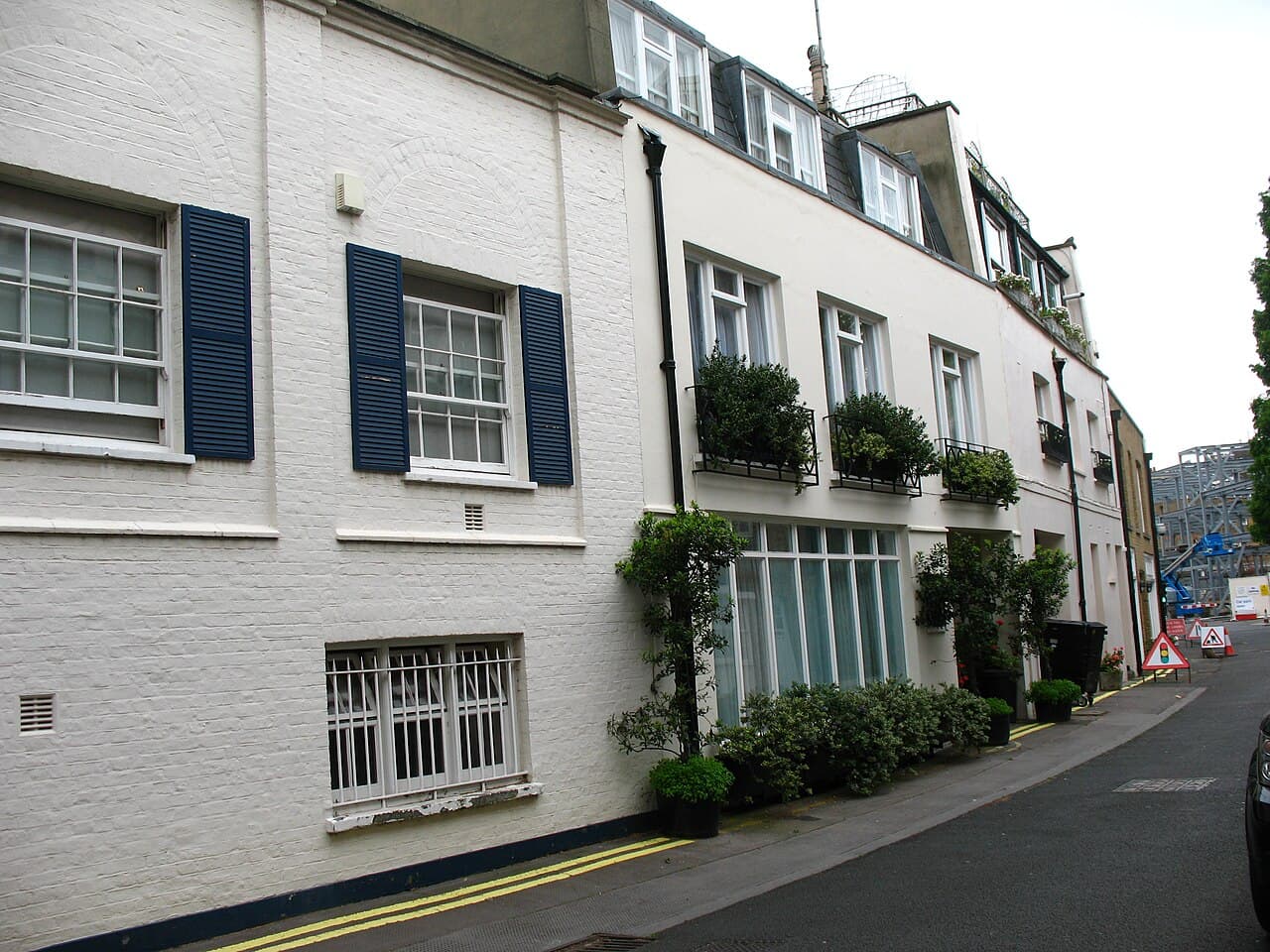
44 Kinnerton Street: Ghislaine Maxwell's London Townhouse in Belgravia
How a discreet mews house in one of London's most exclusive neighborhoods became the backdrop to the most consequential photograph in the Epstein case — and a key node in a transatlantic trafficking network.
44 Kinnerton Street: A Belgravia Address
Kinnerton Street is a quiet, cobbled mews lane tucked behind the grand terraces of Belgravia, one of London's wealthiest residential districts. The area, developed by the Grosvenor Estate in the early 19th century, sits between Knightsbridge and Hyde Park Corner — a short walk from Harrods, the Lanesborough Hotel, and the embassies that line Belgrave Square. Number 44, a modest-looking mews-style property, belied the social significance of its occupant.
Ghislaine Maxwell, the daughter of the late media baron Robert Maxwell, maintained this address as her London base during the late 1990s and early 2000s. After her father's death in 1991 and the collapse of his publishing empire amid revelations of massive pension fund fraud, Ghislaine had relocated to New York, where she entered Jeffrey Epstein's orbit. But she retained deep connections to London society — connections that the Kinnerton Street property helped her maintain.
The March 2001 Photograph: Prince Andrew and Virginia Giuffre
The townhouse at 44 Kinnerton Street became globally significant because of a single photograph taken there in early March 2001. The image shows Prince Andrew, Duke of York, standing with his arm around the bare waist of a young Virginia Roberts (later Virginia Giuffre), who was 17 years old at the time. Ghislaine Maxwell stands in the background, smiling. The photograph was taken in what appears to be a first-floor hallway or landing of the property.
This photograph, first published by the Mail on Sunday in 2011, would become the single most recognizable image of the Epstein scandal. It placed a senior member of the British Royal Family in direct physical proximity to an alleged trafficking victim, inside a property controlled by Epstein's closest associate. The image was later submitted as evidence in multiple civil proceedings and was referenced extensively in Giuffre's lawsuit against Prince Andrew.
Maxwell's London Social Network and Aristocratic Connections
Ghislaine Maxwell's value to Jeffrey Epstein was, in significant part, her social capital. Born into British high society as the youngest child of Robert Maxwell — who owned the Daily Mirror, Pergamon Press, and Macmillan Publishers — she had grown up in Headington Hill Hall, a 53-room mansion in Oxfordshire. She was educated at Marlborough College and Balliol College, Oxford, and moved in circles that included European aristocracy, senior politicians, and the British establishment.
From the Kinnerton Street address, Maxwell maintained relationships with figures across London society. She attended charity galas, private dinners, and social events, frequently bringing Epstein into contact with influential British figures. Court documents and testimony from the Maxwell trial revealed that she acted as a bridge between Epstein's American operations and the upper echelons of British social life — leveraging her family name and connections to provide Epstein with access and credibility he could not have obtained on his own.
Virginia Giuffre's Testimony: London Visits and the Tramp Nightclub Evening
In her depositions and civil court filings, Virginia Giuffre provided detailed testimony about her time in London. She described being flown to the UK by Epstein and Maxwell on multiple occasions. On the evening in question — believed to be in early March 2001 — Giuffre testified that Maxwell took her to Tramp, an exclusive members-only nightclub on Jermyn Street in Mayfair, where she was introduced to Prince Andrew.
According to Giuffre's account, the group — which included Prince Andrew, Maxwell, and Giuffre — spent the evening at the nightclub before returning to Maxwell's Kinnerton Street townhouse, where the photograph was taken. Giuffre alleged that she was subsequently directed by Maxwell to provide sexual services to Prince Andrew. She described the London visit as part of a broader pattern in which she was trafficked to multiple locations internationally, including New York, the US Virgin Islands, and Paris.
Giuffre's testimony about the London events was consistent across multiple depositions and public statements spanning more than a decade. The photograph taken at 44 Kinnerton Street served as corroborating evidence for her account of the evening.
Prince Andrew's Denials and the February 2022 Settlement
Prince Andrew consistently denied Virginia Giuffre's allegations. In a November 2019 interview with BBC Newsnight — widely regarded as one of the most disastrous royal interviews in modern history — the Duke of York claimed he had no recollection of meeting Giuffre and suggested the photograph may have been fabricated. He also offered an alibi for the evening in question, stating he had taken his daughter Princess Beatrice to a party at a Pizza Express restaurant in Woking, Surrey.
In August 2021, Virginia Giuffre filed a civil lawsuit against Prince Andrew in the United States District Court for the Southern District of New York (Giuffre v. Prince Andrew, 21-cv-6702). The lawsuit alleged sexual assault during the London visit and on other occasions. Prince Andrew's legal team initially sought to have the case dismissed, arguing that a 2009 settlement between Giuffre and Epstein released all associated parties.
In February 2022, the case was settled out of court. While the exact terms were confidential, reports indicated the settlement was in the region of £12 million. Prince Andrew made no admission of liability but issued a statement acknowledging Giuffre's bravery and pledging a "substantial donation" to her charity supporting victims' rights. The settlement effectively ended the prospect of a public trial in which the Kinnerton Street photograph and Giuffre's London testimony would have been presented to a jury.
British Metropolitan Police Investigation and Criticism
The Metropolitan Police Service (the Met) faced sustained public criticism over its handling of allegations connected to Epstein and Maxwell's activities in London. In 2015, following the emergence of Giuffre's allegations in US court filings, the Met conducted a review but concluded there was insufficient evidence to open a formal criminal investigation.
This decision was revisited in August 2021, when the Met announced a fresh review following the settlement of the Giuffre case and Maxwell's conviction in New York. However, in June 2022, the Met again concluded that no investigation would be opened, citing an assessment that "no one in the UK has been charged as part of any investigation" and that there was "no viable line of inquiry." Critics, including lawyers for Epstein victims and members of Parliament, argued that the Met had failed to pursue credible allegations of trafficking offenses committed on British soil, particularly at the Kinnerton Street address.
London as a Node in the International Trafficking Network
Court documents and witness testimony presented during the Maxwell trial (United States v. Maxwell, 20-cr-330) established that Epstein and Maxwell operated across multiple international jurisdictions. London served as a critical transit point between Epstein's US-based operations — centered on New York and Palm Beach — and his European activities, particularly the apartment at 22 Avenue Foch in Paris and Jean-Luc Brunel's modeling network in France.
Maxwell's London residence at 44 Kinnerton Street functioned as the staging ground for this British dimension of the network. From Belgravia, Maxwell could access her social connections, host gatherings that introduced Epstein to potential targets and allies, and facilitate the movement of young women between the United States and Europe. Flight logs from Epstein's aircraft show regular transatlantic trips between the US and London, with Maxwell frequently listed as a passenger.
The Kinnerton Street townhouse thus occupied a specific and consequential role in the broader Epstein operation: it was the London anchor of a network that spanned at least four countries and relied on the movement of victims between properties controlled by Epstein and his associates.
Timeline: 44 Kinnerton Street & London Events
1991
Robert Maxwell dies; Ghislaine relocates to New York and enters Jeffrey Epstein's circle
Late 1990s
Maxwell maintains 44 Kinnerton Street as her London residence while based in New York
Early March 2001
Virginia Giuffre (then Roberts), age 17, is brought to London by Maxwell; the group visits Tramp nightclub
March 2001
Photograph of Prince Andrew with arm around Virginia Giuffre taken at 44 Kinnerton Street; Maxwell visible in background
2011
Mail on Sunday publishes the Kinnerton Street photograph; image becomes globally recognizable
2015
Metropolitan Police reviews Giuffre's allegations; declines to open formal investigation
Nov 2019
Prince Andrew's BBC Newsnight interview; claims no recollection of meeting Giuffre and suggests photo may be fabricated
Aug 2021
Giuffre files civil lawsuit against Prince Andrew in SDNY (21-cv-6702)
Aug 2021
Met Police announces fresh review of London allegations
Dec 2021
Ghislaine Maxwell convicted on five federal charges including sex trafficking at SDNY trial
Feb 2022
Prince Andrew settles Giuffre lawsuit for ~£12 million; no admission of liability
June 2022
Metropolitan Police concludes second review; again declines to investigate