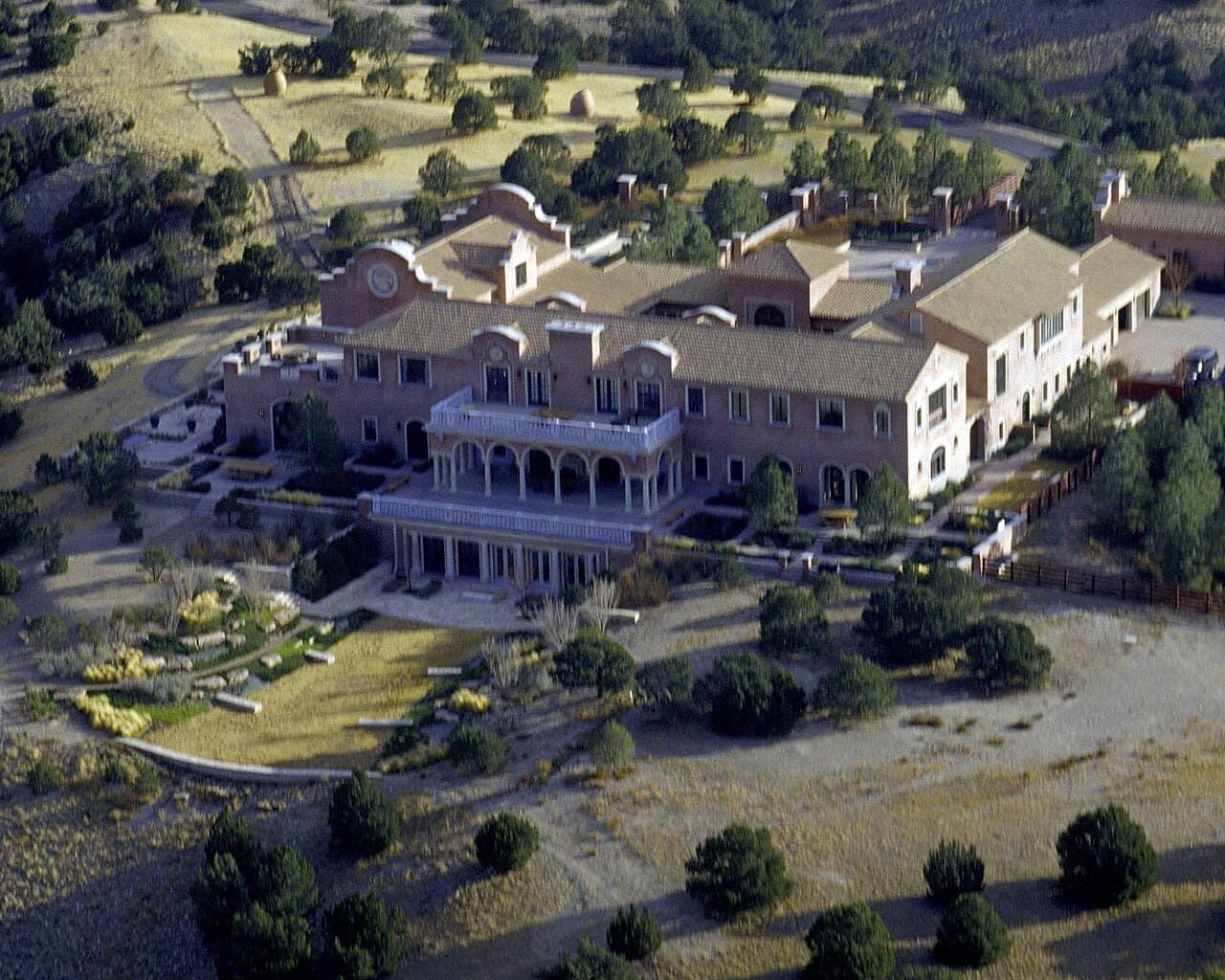
Zorro Ranch, Stanley, New Mexico
Zorro Ranch: Inside Jeffrey Epstein's 10,000-Acre New Mexico Compound, Annie Farmer's Testimony, and the Eugenics Program That Never Was
In the high desert south of Santa Fe, Epstein maintained the most isolated property in his real estate portfolio — a 10,000-acre ranch with its own airstrip, where scientific gatherings mixed with abuse, a 16-year-old girl was victimized far from anyone who could help, and plans for a bizarre DNA-seeding program were discussed with some of the world's leading scientists.
The Ranch in the High Desert
Zorro Ranch is located outside the small unincorporated community of Stanley, New Mexico, approximately 35 miles southeast of Santa Fe in Santa Fe County. The property encompasses roughly 10,000 acres of high desert terrain — arid grasslands, mesas, and scattered pinon-juniper woodland at an elevation of approximately 6,200 feet. The nearest town of any size is Moriarty, about 20 miles to the east along Interstate 40. The ranch's remoteness was its defining characteristic: it sat at the end of a long, unpaved access road, miles from the nearest neighbor, invisible from any public highway, and accessible primarily by private aircraft through its own landing strip.
Epstein acquired the property in the mid-1990s, making it one of the earliest purchases in his eventual portfolio of residences spanning New York, Palm Beach, Paris, and the US Virgin Islands. The ranch predated his acquisition of Little St. James Island (1998) and was contemporaneous with his period of greatest access to the New York social and financial elite. Over the following two decades, Epstein developed the raw ranch land into a compound that included a large main residence, multiple guest houses, staff quarters, horse facilities, a fire station, an equipment barn, and the private airstrip that allowed him to fly in and out without passing through any commercial airport.
The Private Airstrip: Gateway to Isolation
The private airstrip on Zorro Ranch was a critical piece of infrastructure. The paved runway, long enough to accommodate business jets, allowed Epstein and his guests to arrive and depart entirely outside the commercial aviation system. Unlike the Teterboro-to-St. Thomas routes that generated the extensive flight log records for the Boeing 727 and Gulfstream, flights into Zorro Ranch's private strip left a smaller documentary footprint. General aviation flights to private airstrips are subject to less rigorous passenger manifest requirements than commercial airport operations, making the ranch a destination where arrivals and departures were harder to track.
Prosecutors and investigators noted that the combination of a private airstrip and extreme geographic isolation made Zorro Ranch uniquely suited to activities that Epstein wished to conduct away from scrutiny. Unlike the Manhattan townhouse — in the heart of one of the most densely populated neighborhoods in the world — or the Palm Beach mansion — surrounded by other estates and under police surveillance during the 2005 investigation — the ranch offered thousands of acres of buffer between the compound and any outside observer.
Annie Farmer's Testimony: Abuse at Age Sixteen
Annie Farmer was one of the most significant witnesses in the federal case against Ghislaine Maxwell. Farmer testified at Maxwell's December 2021 trial that she was lured to Zorro Ranch in 1996 when she was 16 years old, under the pretense of visiting with her older sister, Maria Farmer, who had worked for Epstein. Annie Farmer's testimony provided one of the most detailed accounts of abuse at the New Mexico property.
According to Farmer's trial testimony, she was flown to New Mexico and driven to the remote ranch. Once there, she described being subjected to a sexualized massage by Maxwell and sexual abuse by Epstein. Farmer testified that she felt trapped by the ranch's isolation — with no vehicle, no phone access, and no way to leave the property without Epstein's cooperation. The geographic remoteness that Epstein had cultivated as a feature of the property functioned, in Farmer's account, as a tool of control and coercion.
Farmer's testimony was notable for several reasons. She was one of the few victims who testified using her real name rather than a pseudonym, a decision she described as deliberate. Her account established that Epstein and Maxwell's abuse was not limited to the more frequently discussed locations — the Manhattan townhouse, Palm Beach mansion, or Caribbean islands — but extended to the New Mexico ranch. The Zorro Ranch abuse occurred in the mid-1990s, placing it among the earliest documented incidents in the criminal timeline and demonstrating that Epstein's pattern of targeting minors was established long before his first arrest in 2005.
Scientific Gatherings and High-Profile Visitors
Zorro Ranch served as a venue for gatherings that Epstein organized with scientists, academics, and technology executives. These events, which Epstein framed as intellectual salons or research brainstorming sessions, brought prominent figures to the remote compound for multi-day visits. The gatherings were part of Epstein's broader strategy of cultivating relationships with the scientific establishment — a strategy that also included donations to universities, the funding of research programs, and the establishment of the Jeffrey Epstein VI Foundation.
Bill Gates visited Zorro Ranch on multiple occasions, as documented by The New York Times in their October 2019 investigation. Gates acknowledged meeting with Epstein multiple times beginning in 2011, stating that the meetings concerned philanthropy. A spokesperson for Gates later said that Gates "regrets" the association. The visits to the ranch were notable because they occurred after Epstein's 2008 guilty plea and sex offender registration in Florida — meaning that the meetings took place after Epstein was a convicted sex offender and registered as such.
Other scientists and academics who attended events at the ranch or were connected to Epstein's scientific network included theoretical physicist Lawrence Krauss, who organized physics symposia that Epstein funded; artificial intelligence researcher Marvin Minsky (who died in 2016); and geneticist George Church of Harvard, who received research funding from Epstein. The breadth of Epstein's scientific connections has been the subject of extensive reporting and institutional investigations at multiple universities, including Harvard and MIT.
The Eugenics Obsession and DNA-Seeding Plans
In July 2019, The New York Times reported that Epstein had discussed plans to "seed the human race with his DNA" by impregnating multiple women at Zorro Ranch. According to the report, which cited scientists and other individuals who had spoken with Epstein about the idea, Epstein envisioned using the ranch as a base for a breeding program. The plan, which was never implemented, reflected what the Times characterized as Epstein's longstanding interest in eugenics and transhumanism — the idea of using technology and selective breeding to direct human evolution.
Epstein reportedly discussed these ideas with scientists at gatherings on the ranch and at dinners in New York. Several scientists told the Times that Epstein had expressed admiration for the concept of improving the human species through controlled reproduction, a position that alarmed some attendees. The discussions reportedly included Epstein's desire to have 20 women impregnated at a time at the ranch, with the compound serving as the physical location for this program.
The eugenics reporting placed Epstein's scientific interests in a deeply unsettling context. Rather than representing genuine intellectual curiosity, the ranch-based plans suggested that Epstein viewed science as an extension of his pathological desire for control — specifically, control over women's bodies and reproductive capacity. The connection between his trafficking operation and his stated scientific ambitions raised questions about whether the two were, in Epstein's mind, related projects.
New Mexico Attorney General Investigation
Following Epstein's arrest and death in 2019, the New Mexico Attorney General's office opened an investigation into potential sex trafficking and abuse at Zorro Ranch. Attorney General Hector Balderas stated publicly that his office was investigating "potential criminal activity" at the ranch, making New Mexico the second jurisdiction (after the USVI) to pursue state-level investigation of Epstein's activities outside of the federal cases in New York and Florida.
The investigation focused on whether New Mexico state laws had been violated at the ranch, including statutes related to sexual abuse of minors, human trafficking, and conspiracy. Investigators examined the flow of visitors to the ranch, the role of Epstein employees in facilitating contact between Epstein and young women, and the use of the private airstrip to transport individuals to and from the compound. The ranch's location in Santa Fe County placed it within the jurisdiction of New Mexico state courts, creating an independent legal avenue for accountability separate from the SDNY federal prosecution and the USVI civil action.
The New Mexico investigation also examined whether local officials or law enforcement had received complaints about activities at the ranch prior to Epstein's 2019 arrest and, if so, what action had been taken. The ranch's isolation had functioned as a barrier not only to victims seeking escape but also to any form of routine law enforcement oversight — a dynamic that prosecutors in multiple jurisdictions identified as a deliberate feature of Epstein's property selection strategy.
The Ranch in the Property Network
Zorro Ranch was one node in a network of properties that prosecutors described as purpose-built for trafficking. The Manhattan townhouse served as the operational headquarters and primary recruitment site. The Palm Beach mansion was where the abuse pattern was first investigated by police. The Caribbean islands offered oceanic isolation. But the ranch was unique in the portfolio: it offered the most extreme terrestrial isolation of any Epstein property, surrounded by thousands of acres of empty desert with no neighbors, no public roads in sight, and an airstrip that meant victims could be transported there without ever passing through a public space.
Timeline: Zorro Ranch
Mid-1990s
Jeffrey Epstein acquires approximately 10,000 acres near Stanley, New Mexico and begins developing Zorro Ranch
1996
Annie Farmer, then 16, is brought to Zorro Ranch and sexually abused by Epstein and Maxwell
Late 1990s
Ranch compound expanded: main residence, guest houses, staff quarters, horse facilities, and private airstrip constructed
2000s
Epstein begins hosting scientific gatherings and intellectual salons at the ranch, attracting prominent researchers
2008
Epstein pleads guilty in Florida; registers as sex offender. Ranch visits by high-profile figures continue afterward
2011-2014
Bill Gates visits Zorro Ranch on multiple occasions; meetings characterized as concerning philanthropy
July 2019
New York Times reports Epstein discussed plans to 'seed the human race with his DNA' using the ranch as a base
July 6, 2019
Epstein arrested on federal sex trafficking charges
Aug 2019
New Mexico AG Hector Balderas opens state investigation into potential criminal activity at Zorro Ranch
Dec 2021
Annie Farmer testifies at Ghislaine Maxwell trial about abuse at Zorro Ranch in 1996
Dec 29, 2021
Maxwell convicted on five of six counts, including sex trafficking; Farmer's ranch testimony cited in verdict