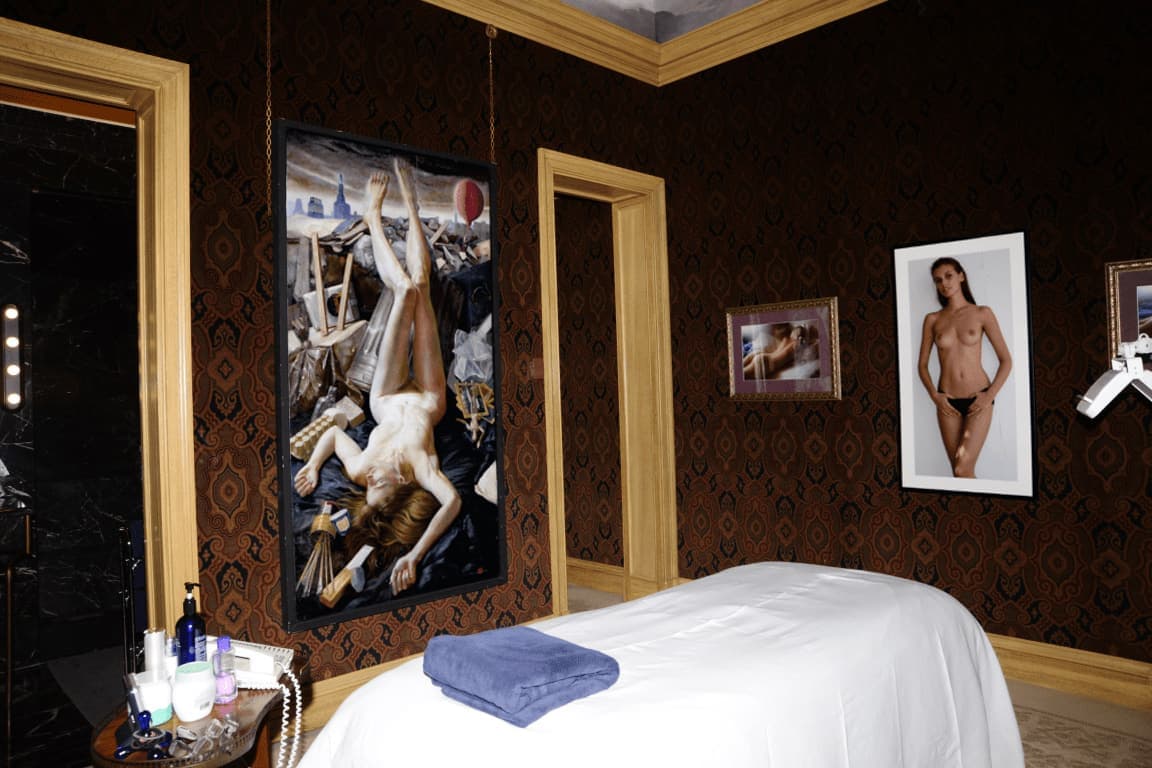
358 El Brillo Way, Palm Beach

The second-floor massage room at Epstein's Palm Beach estate — the most extensively documented crime scene in the federal and state investigations.

The Massage Room at 358 El Brillo Way: Inside Epstein's Palm Beach Crime Scene

More than 30 victims described the same room, the same routine, and the same escalation of abuse. This is the story of how a second-floor room became the most documented crime scene in the Epstein case — told through the words of those who were there.

Sources: Maxwell Trial Testimony, Palm Beach PD Reports, SDNY Victim Depositions, Grand Jury Records

The Room: Physical Layout and Setup

The room at the center of the Epstein case was located on the second floor of the mansion at 358 El Brillo Way, an affluent residential street in Palm Beach, Florida. According to testimony from multiple witnesses and law enforcement reports, the room was set up as a massage space. It contained a professional-grade massage table positioned in the center of the room, a couch or daybed along one wall, a shower or bathroom accessible from within the room, and shelves stocked with lotions, oils, and towels. The windows were typically covered to maintain privacy. Victims described the lighting as dim, with the atmosphere intentionally designed to feel clinical yet isolating.

What made this room legally significant — and ultimately devastating to Epstein's defense — was the extraordinary consistency of the descriptions provided by dozens of independent witnesses. Women and girls who had never met one another, interviewed years apart by different law enforcement agencies, described the same physical layout, the same sequence of events, and the same escalation pattern. This consistency would become the prosecution's strongest weapon.

Juan Alessi and the Household Manual

Juan Alessi served as the house manager of the Palm Beach property for approximately 11 years, from the early 1990s until around 2002. His testimony, delivered at the Ghislaine Maxwell trial in December 2021, provided the most detailed insider account of how the household operated — and how the massage room functioned within the broader system of abuse.

Alessi testified about a written "household manual" — a 58-page document that dictated the exact procedures for running the property. Among its many instructions, the manual specified rules that, viewed in hindsight, were designed to facilitate and conceal criminal activity. Staff were instructed to never look at or make eye contact with guests arriving at the residence. They were told to "see nothing, hear nothing, say nothing" regarding Epstein's activities and visitors. The manual stipulated that the massage room was to be cleaned and restocked after each "session" — fresh towels, new lotions, clean sheets on the massage table.

Alessi testified that after every visit by a young woman or girl, he was responsible for entering the massage room to clean up. He described finding sex toys, used towels, and other items that made the nature of what occurred in the room unmistakable. He estimated that he cleaned the room after visits by young women "hundreds of times" during his years of employment. Alessi stated that the girls who came to the property appeared increasingly young over the years. He identified Ghislaine Maxwell as playing a direct role in scheduling and facilitating the visits.

Carolyn's Testimony: Hundreds of Visits Starting at Age 14

Among the most powerful testimony in the Epstein case came from a woman identified during the Maxwell trial only by her first name, Carolyn. She testified that she was first brought to Epstein's Palm Beach home in approximately 2002, when she was 14 years old. She had been recruited by another girl — a friend from school who told her she could earn $300 for giving a massage to a wealthy man.

Carolyn described arriving at the El Brillo Way property and being led upstairs to the second-floor massage room. She testified that the initial encounter followed what she would later understand to be a fixed pattern: she was instructed to undress and give Epstein a massage using the oils provided. The encounter escalated to sexual abuse. At the end, Epstein paid her in cash — typically $300 — and told her to come back.

Carolyn testified that she returned to the massage room approximately 100 to 200 times over the following three years. Each visit followed the same pattern. She stated that Ghislaine Maxwell was present during multiple visits, sometimes calling to schedule appointments and on at least one occasion touching Carolyn directly. Carolyn also testified that Maxwell would ask her to recruit other girls, offering additional payments for each new girl she brought to the property. Carolyn estimated that she recruited approximately four to five other underage girls through this system.

The Recruitment Chain

One of the most insidious aspects of the operation centered on the massage room was its self-perpetuating recruitment structure. Victims were paid not only for their own visits but for bringing additional girls. The typical fee structure, according to multiple witnesses, was $200 to $300 for a "massage" visit and an additional $200 for each new girl recruited. This created a pyramid-like system in which victims became recruiters, often bringing friends, classmates, or acquaintances from their schools and social circles in the Palm Beach and West Palm Beach areas.

The recruitment chain targeted a specific demographic: girls aged approximately 14 to 17, often from disadvantaged backgrounds, who were lured by the promise of easy money. Courtney Wild, one of the most prominent named victims, has publicly stated that she was 14 when she was first recruited and that she subsequently brought other girls to the mansion. The structure was deliberately designed so that Epstein and Maxwell maintained distance from the initial recruitment — the girls were approached by peers, not by adults, which both lowered their guard and complicated later prosecution efforts. Prosecutors identified this peer recruitment as a hallmark of trafficking operations.

Detective Joseph Recarey's Investigation

The Palm Beach Police Department's investigation of the massage room and the activities that took place there was led by Detective Joseph Recarey beginning in March 2005. The investigation was initiated after the mother of a 14-year-old girl contacted police to report that her daughter had been taken to Epstein's mansion and paid for sexual acts. Recarey, working with Detective Gregory Pagan and others in the department, began systematically identifying and interviewing victims.

Over the course of the investigation, Recarey and his colleagues identified and interviewed more than 30 young women and girls who described being taken to the same second-floor massage room and subjected to strikingly similar abuse. The girls described the same physical layout, the same instructions they were given, the same escalation pattern, and the same payment amounts. Detective Pagan documented the accounts meticulously, creating a case file that demonstrated a clear pattern of predatory behavior targeting minors.

The detectives also obtained physical evidence from the property through a search warrant executed in October 2005. The warrant produced items from the massage room including the massage table itself, multiple bottles of massage oil, photographs of young women in various stages of undress, a journal with names and phone numbers, and other personal items. Phone records and scheduling books recovered from the property showed a pattern of multiple short appointments per day, consistent with the victims' accounts. Recarey later testified that the volume and consistency of the victim statements made this the strongest case he had worked in his career. Detective Recarey passed away in May 2018, just months before the federal case was revived.

The Pattern of Abuse

The victim testimony, taken collectively, described a remarkably consistent pattern. A girl would arrive at the El Brillo Way property, typically in the afternoon. She would be greeted by a member of the household staff — sometimes Alessi, sometimes another employee — and led upstairs to the second-floor massage room. In the room, she would find Epstein in a towel or robe. She would be instructed to undress and begin massaging him using the oils available. The encounter would escalate to sexual contact initiated by Epstein. After the encounter, the girl would be paid in cash and asked if she could return or bring a friend.

The repetition of this pattern across dozens of independent witnesses eliminated any reasonable claim that the encounters were isolated incidents or misunderstandings. Prosecutors in both the 2008 state case and the 2019 federal case characterized the massage room as the operational center of a sex trafficking enterprise — a fixed location where the same crime was repeated systematically over a period of years. The room itself, more than any other single piece of evidence, demonstrated the premeditated and organized nature of Epstein's crimes.

The Room as Evidence at Trial

Although Epstein never stood trial on the federal charges — the indictment was dismissed following his death in August 2019 — the massage room testimony was central to the prosecution of Ghislaine Maxwell. During the Maxwell trial in November and December 2021, multiple witnesses testified about their experiences in the second-floor room. Carolyn's testimony about her hundreds of visits, Alessi's account of cleaning the room and the household manual, and the accounts of other victims all pointed to Maxwell's role in facilitating access to the room and to the girls who were brought there. The jury convicted Maxwell on five of six counts, including sex trafficking of a minor.

The massage room at 358 El Brillo Way stands as the physical location most closely associated with Epstein's crimes. While abuse occurred at multiple properties across multiple jurisdictions, it was in this room that the largest number of victims were identified, the most detailed testimony was gathered, and the pattern of systematic predatory behavior was most clearly documented. For the survivors who testified, the room represented both the site of their trauma and, ultimately, the evidence that would bring accountability — if not for Epstein himself, then for his most prominent accomplice.

Timeline: The Massage Room Investigation

~1999

Epstein begins scheduling regular 'massage' appointments at the Palm Beach property with young women and girls

~2002

Carolyn, age 14, is first recruited and brought to the second-floor massage room

March 2005

Mother of a 14-year-old contacts Palm Beach Police; Detective Recarey opens investigation

2005

Detectives Recarey and Pagan identify and interview 30+ victims describing the same room and pattern

October 2005

Palm Beach PD executes search warrant; recovers massage table, photos, oils, and personal items

2006

Palm Beach PD refers case to FBI and SDNY; federal investigation begins

September 2007

Non-prosecution agreement reached with Alexander Acosta's office; victims not consulted

June 2008

Epstein pleads guilty to state prostitution charges; avoids federal trial

May 2018

Detective Joseph Recarey dies at age 50 before federal case is revived

July 2019

SDNY federal indictment charges Epstein with sex trafficking based on Palm Beach evidence

Nov–Dec 2021

Carolyn, Alessi, and others testify about the massage room at the Ghislaine Maxwell trial

Dec 29, 2021

Maxwell found guilty; massage room testimony cited as central evidence

Related Evidence & Sections

All information sourced from publicly available court documents, DOJ reports, trial testimony, and investigative reporting.

Privacy|Terms