The facade of Jeffrey Epstein's townhouse at 9 East 71st Street on the Upper East Side of Manhattan, New York City
9 East 71st Street, Manhattan — Jeffrey Epstein's primary residence and the site of the July 6, 2019 FBI raid. One of the largest private homes in New York City.

9 East 71st Street: The Secret History of Jeffrey Epstein's New York Townhouse

How a 40-room Gilded Age mansion on Manhattan's Upper East Side became the nerve center of one of America's most notorious criminal enterprises — and what the FBI found behind its locked doors.

Sources: Property Records, FBI Documents, SDNY Filings

A Gilded Age Mansion on the Upper East Side

The seven-story limestone townhouse at 9 East 71st Street sits just off Fifth Avenue on Manhattan's Upper East Side, one of the most exclusive residential corridors in the world. Originally constructed in the 1930s, the approximately 28,000-square-foot mansion was built for Herbert N. Straus, an heir to the Macy's department store fortune and a co-owner of Abraham & Straus department stores. The Neo-Georgian facade, designed to blend with the surrounding townhouses of the Lenox Hill neighborhood, concealed a residence of extraordinary scale — roughly 40 rooms spread across seven floors, making it one of the largest private residences in all of Manhattan.

After the Straus family, the building served for decades as home to the Birch Wathen School (now Birch Wathen Lenox), a prestigious private school that operated out of the building from the 1960s through the 1980s. The institutional use preserved the building's grand public spaces — sweeping staircases, formal reception rooms, and oversized windows that flooded the interior with light — while adding the functional layout of classrooms and assembly halls.

Les Wexner's Purchase and the Epstein Transfer

In 1989, Leslie "Les" Wexner, the billionaire founder and CEO of The Limited (parent company of Victoria's Secret, Bath & Body Works, and other retail brands), purchased the property and undertook an extensive renovation to convert it back into a single-family residence. Wexner reportedly spent tens of millions on the renovation, transforming the former school building into a lavish private home with custom interiors befitting one of America's wealthiest executives.

It was during this period that Jeffrey Epstein entered Wexner's orbit. Epstein, who had cultivated an image as a mysterious financial advisor to billionaires, became Wexner's personal money manager. Their financial relationship — the full extent of which remains unclear — would become one of the most scrutinized connections in the Epstein case.

In 1998, the townhouse was transferred from Wexner to Epstein. The exact terms of this transfer have been the subject of intense investigation and public debate. Property records and subsequent reporting have indicated that the mansion may have been transferred for as little as $0. Wexner later stated through a spokesperson that he had "severed ties" with Epstein and that Epstein had "misappropriated vast sums of money" from him. However, Wexner did not elaborate publicly on the circumstances of the real estate transfer itself.

At the time of the transfer, the property was already valued in the tens of millions of dollars. By the time of Epstein's arrest in 2019, the townhouse was estimated to be worth approximately $56 million, according to assessments cited in federal court filings.

Inside the Townhouse: Layout and Interior

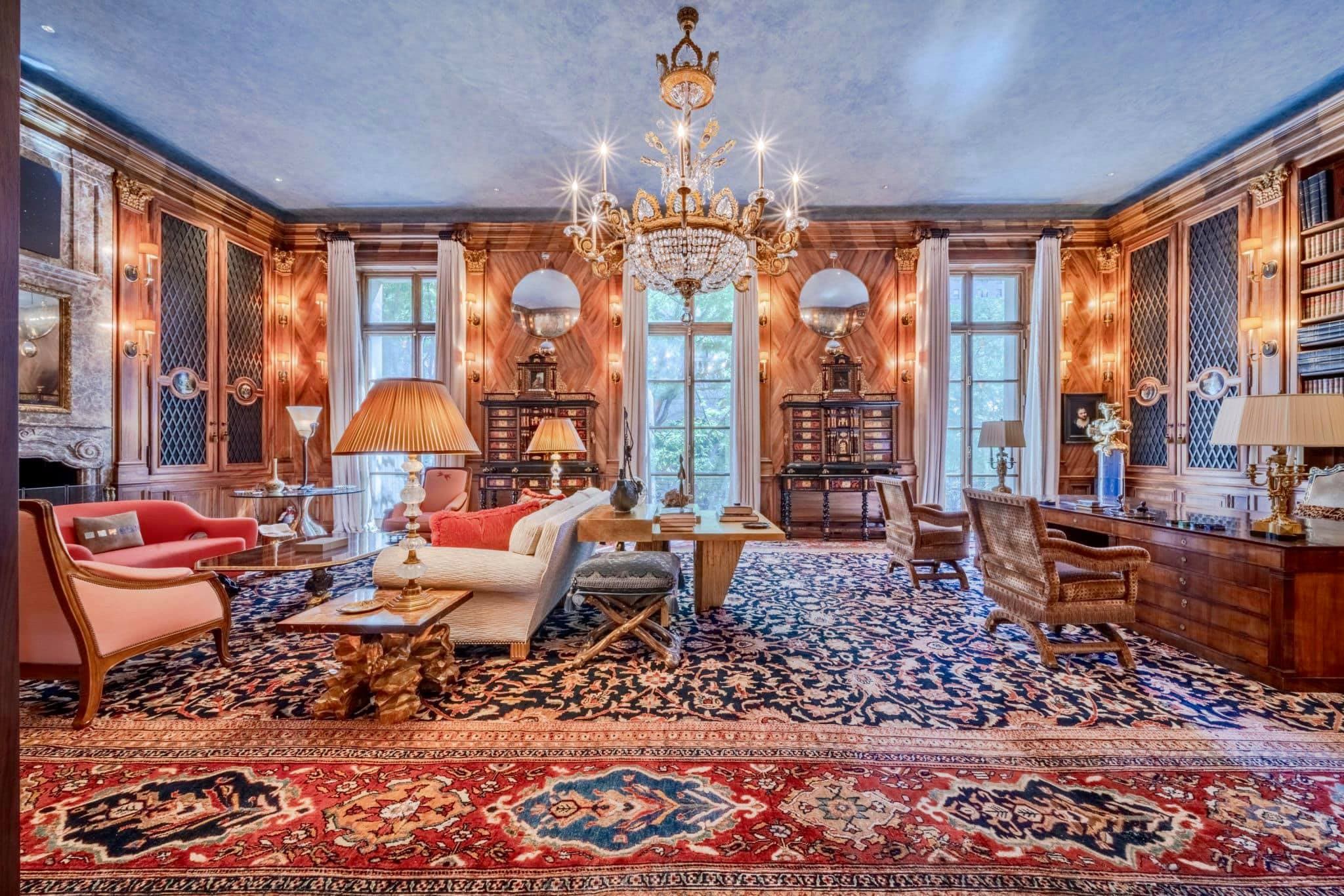
Court documents, witness testimony, and reports from the FBI raid have provided details about the interior of the residence. The townhouse featured a grand entrance foyer, a sweeping staircase, a formal dining room, multiple sitting rooms, and a top-floor master suite. The building included a gym, staff quarters, a commercial kitchen, and an elevator connecting the seven floors.

Witnesses and former employees described unusual decor choices. Among the most widely reported details: a mural in the entrance depicting Epstein in a prison setting (painted before any of his legal troubles), a stuffed tiger, a life-size female mannequin hanging from a chandelier, rows of framed eyeballs sourced from a British hospital, and walls lined with photographs — many featuring Epstein alongside prominent figures from politics, entertainment, science, and finance.

Testimony from employees and victims described a so-called "massage room" on the upper floors where much of the documented abuse took place. Juan Alessi, a former house manager who testified at the Ghislaine Maxwell trial, described his responsibilities maintaining the property and the instructions he received regarding young women who visited the residence.

The FBI Raid: July 6, 2019

On July 6, 2019 — one day after Epstein was arrested upon landing at Teterboro Airport in New Jersey on a flight from Paris — FBI agents executed a search warrant at 9 East 71st Street. The raid, conducted by the Public Corruption Unit of the Southern District of New York, would prove to be one of the most consequential searches in the case.

Agents forced entry after Epstein's legal team declined to provide immediate access. Inside, investigators discovered evidence that would form the backbone of the federal indictment. The most significant find was a locked safe in a closet off the master bedroom. When agents pried it open, they found:

  • Compact discs in a case, individually labeled with handwritten descriptions including names of individuals. The contents of these discs were sealed by court order.
  • Loose diamonds and a large quantity of cash in multiple currencies.
  • An expired Saudi Arabian passport issued in the 1980s bearing Epstein's photograph but a different name and listing his residence as Saudi Arabia. Prosecutors would later reference this passport as evidence of Epstein's flight risk during bail proceedings.

Agents also found "hundreds — and perhaps thousands — of sexually suggestive photographs of fully or partially nude females," according to the SDNY indictment. Some of these photographs depicted individuals who appeared to be minors. These were found on CDs and in hard copy throughout the residence.

The Bail Hearing and Property as Evidence

The contents of the townhouse played a significant role in Epstein's bail hearing before Judge Richard Berman on July 15, 2019. Prosecutors argued that the safe's contents — the fake passport, diamonds, and cash — demonstrated that Epstein had the means and preparation to flee the country. Defense attorneys offered the mansion itself as part of a proposed bail package valued at over $100 million, which would have included the 71st Street property, his private jet, and electronic monitoring.

Judge Berman denied bail on July 18, 2019, citing the evidence found in the raid and the severity of the charges. Epstein remained in custody at the Metropolitan Correctional Center until his death on August 10, 2019.

Epstein's New York Real Estate Network

The 71st Street townhouse was not Epstein's only New York property. Records show he also owned or controlled apartments in other Manhattan buildings, including a unit at 301 East 66th Street. This Upper East Side address was used to house some of the young women who were recruited into his operation, according to court filings and witness testimony.

Epstein's broader real estate portfolio was expansive: the Palm Beach mansion at 358 El Brillo Way, the Zorro Ranch in Stanley, New Mexico, the apartment at 22 Avenue Foch in Paris, and two private islands in the US Virgin Islands — Little St. James and Great St. James. Together, these properties formed a network of residences that prosecutors described as instrumental to Epstein's trafficking operation, allowing him to move victims between jurisdictions.

Sale of the Property

Following Epstein's death and the subsequent legal proceedings surrounding his estate, the 71st Street townhouse was listed for sale. The property, which had been assessed at approximately $56 million, was ultimately sold in March 2021. The buyer was reported to be connected to former Goldman Sachs executive Michael Daffey, who purchased the property for approximately $51 million — a figure below the pre-scandal valuation, reflecting both the property's notoriety and the broader real estate market conditions during the COVID-19 pandemic.

Proceeds from the sale of Epstein's properties were directed to the Epstein Victims' Compensation Fund, established to provide restitution to survivors. The fund, administered by Jordana Feldman, ultimately paid out over $121 million to more than 135 claimants before closing in August 2021.

The Townhouse in Legal History

9 East 71st Street has become one of the most recognizable addresses in American criminal history. The property served as both the physical headquarters of Epstein's financial and social operations and as a primary crime scene in the federal sex trafficking case. Its transfer from Wexner remains an unresolved question — one that speaks to the larger mystery of how Epstein accumulated his wealth and maintained relationships with some of the most powerful people in the world.

The FBI raid evidence from the townhouse was central to both the initial federal indictment (United States v. Epstein, 19-cr-490) and the subsequent prosecution of Ghislaine Maxwell (United States v. Maxwell, 20-cr-330). Photographs, records, and materials seized from the residence appeared as trial exhibits and were referenced in hundreds of pages of court filings that were unsealed between 2019 and 2024.

Timeline: 9 East 71st Street

1930s

Constructed for Herbert N. Straus (Macy's / Abraham & Straus heir)

1960s

Birch Wathen School begins operating from the building

1989

Les Wexner purchases property for ~$13.2 million; begins extensive renovation

~1990

Jeffrey Epstein becomes Wexner's financial advisor

1998

Property transferred from Wexner to Epstein under disputed terms

2005

Palm Beach investigation begins; NYC property not yet searched

2008

Epstein pleads guilty in Florida; serves 13 months. NYC townhouse not part of plea deal

July 6, 2019

Epstein arrested at Teterboro Airport. FBI raids 71st Street townhouse same day

July 18, 2019

Judge Berman denies bail; cites safe contents as flight risk evidence

Aug 10, 2019

Epstein found dead at Metropolitan Correctional Center

March 2021

Townhouse sold for ~$51 million; proceeds directed to victims' compensation fund

Dec 2021

Evidence from townhouse raid presented at Ghislaine Maxwell trial

Related Evidence & Sections

All information sourced from publicly available court documents (SDNY), FBI investigation records, property filings, and trial exhibits. Property photographs are editorial images used under fair use for documentary and educational purposes.

Privacy|Terms