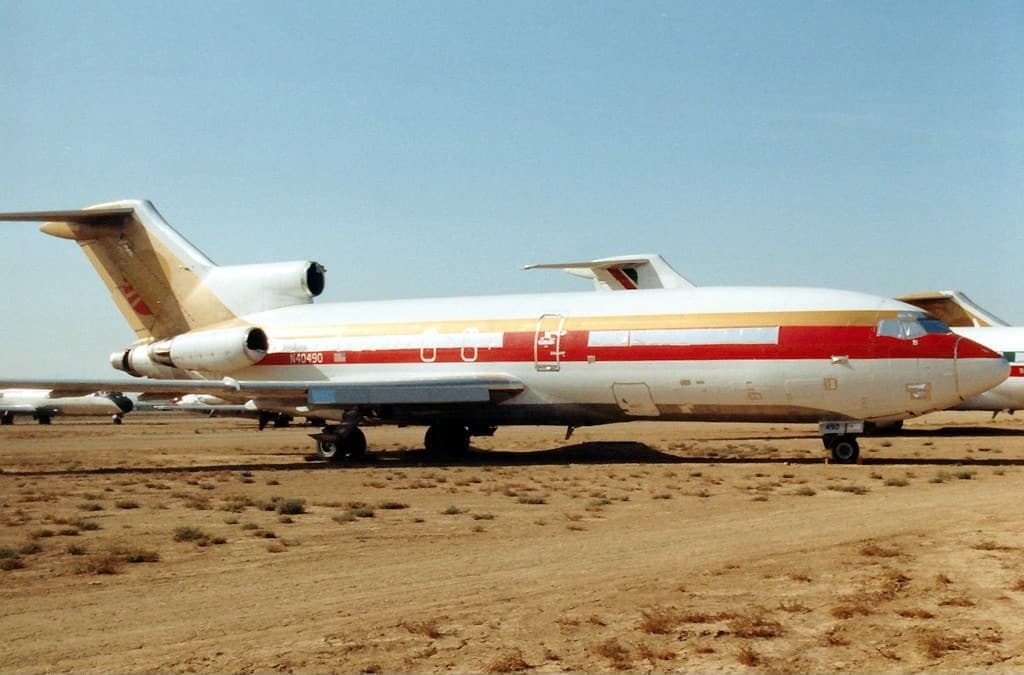
Boeing 727-31 • N908JE

Jeffrey Epstein's Boeing 727-31, tail number N908JE, known publicly as the "Lolita Express." The aircraft flew hundreds of documented trips between Teterboro, Palm Beach, and St. Thomas over more than a decade.

The Lolita Express: Jeffrey Epstein's Boeing 727, the Flight Logs, Pilot Testimony, and the Passenger Manifests That Became Federal Evidence

How a converted Boeing 727-31 airliner became the most infamous private aircraft in modern history — the flight routes that connected Epstein's properties into a trafficking network, the pilots who testified at Ghislaine Maxwell's trial, the handwritten passenger manifests that placed powerful names on specific flights, and the Gulfstream IV that served as Epstein's secondary aircraft for shorter routes.

Sources: FAA Records, Maxwell Trial Testimony, Court-Released Flight Logs, SDNY Filings

The Aircraft: Boeing 727-31 (N908JE)

The aircraft at the center of the Epstein flight log record was a Boeing 727-31, registered under the tail number N908JE. The 727 is a three-engine, narrow-body commercial airliner originally designed for short-to-medium-range routes. In its standard airline configuration, the aircraft could seat approximately 150 to 189 passengers. Epstein's 727 had been extensively converted from its original commercial layout into a private VIP configuration, with the passenger cabin gutted and rebuilt to include private seating areas, a bedroom section, and other amenities suited to long-distance private travel.

The choice of a 727 was unusual for private aviation. The aircraft's size and operating costs far exceeded what was typical for a single individual's personal jet. Even among the ultra-wealthy, private 727s were rare — most high-net-worth individuals operated smaller business jets such as Gulfstreams, Bombardier Challengers, or Dassault Falcons. The 727's capacity, range (approximately 2,500 nautical miles), and payload capability made it suited to carrying larger groups of passengers over the distances between Epstein's properties — particularly the roughly 1,500-mile route from the New York area to the US Virgin Islands.

The aircraft earned the colloquial name "Lolita Express" in media coverage, a reference to Vladimir Nabokov's 1955 novel about a middle-aged man's predatory obsession with a 12-year-old girl. The name was popularized in tabloid coverage and subsequently adopted widely in reporting on the Epstein case. In legal proceedings, the aircraft was identified by its tail number N908JE or simply as "the Boeing 727."

The Gulfstream IV (N120JE): The Secondary Aircraft

In addition to the Boeing 727, Epstein operated a Gulfstream IV registered as N120JE. The Gulfstream IV is a long-range business jet manufactured by Gulfstream Aerospace, capable of carrying up to 19 passengers with a range of approximately 4,200 nautical miles. Where the 727 was the workhorse for transporting larger groups, the Gulfstream served as a more nimble complement — better suited to shorter routes, smaller airports, and trips with fewer passengers.

Flight records show that the Gulfstream frequently operated between Teterboro Airport in New Jersey and Palm Beach International Airport, a route of approximately 1,000 miles that the smaller jet could cover efficiently. The Gulfstream also flew to St. Thomas, to Santa Fe (for trips to Zorro Ranch), and to various international destinations. Both aircraft were maintained, staffed, and operated as part of Epstein's private aviation operation, with dedicated pilots, mechanics, and flight attendants.

The Flight Routes: Teterboro-Palm Beach-St. Thomas

The flight logs revealed a consistent pattern of routes that connected Epstein's primary residences. The three-point triangle of Teterboro Airport (TEB) in New Jersey, Palm Beach International Airport (PBI) in Florida, and Cyril E. King Airport (STT) in St. Thomas constituted the backbone of Epstein's air travel. This triangle connected three of his four domestic properties: the Manhattan townhouse, the Palm Beach mansion, and Little St. James Island (accessed via St. Thomas).

The use of Teterboro Airport was significant. Teterboro is a general aviation airport located in Bergen County, New Jersey, approximately 12 miles from Midtown Manhattan. It is one of the busiest general aviation airports in the United States and is the primary airport used by private jet traffic serving the New York metropolitan area. Teterboro does not serve commercial airlines, which means its passenger screening, manifest requirements, and security protocols differ from those at commercial airports like JFK or LaGuardia. It was at Teterboro that Epstein was arrested on July 6, 2019, upon arriving on a flight from Paris.

Beyond the primary triangle, flight logs also documented trips to international destinations including Paris (connecting to Epstein's apartment at 22 Avenue Foch), various Caribbean islands, and destinations in Africa, Europe, and the Middle East. The international routes added complexity to the jurisdictional questions surrounding the case and demonstrated the global scope of Epstein's travel network.

The Flight Logs: How Passenger Manifests Became Evidence

The flight logs for Epstein's aircraft were maintained by his pilots, primarily by David Rodgers, who served as a pilot for Epstein for approximately 20 years. Rodgers kept handwritten logs documenting the date, route, aircraft, and passengers for each flight. These logs, which covered hundreds of flights over more than a decade, became critical evidence when they were subpoenaed in legal proceedings.

The logs were first obtained by attorneys during civil litigation in the mid-2000s and were subsequently released to the public through court filings. The passenger names recorded in the logs included political figures, business executives, scientists, celebrities, and — critically — young women and girls identified only by first names or initials. The juxtaposition of powerful, recognizable names alongside anonymous or partially identified young females became one of the most widely discussed aspects of the Epstein case.

It is important to note that appearing in the flight logs does not, in itself, constitute evidence of criminal activity. Many of the named passengers were prominent individuals who may have flown on Epstein's aircraft for legitimate purposes — business meetings, social engagements, or travel to charitable events. The evidentiary significance of the logs lay in their ability to place specific individuals at specific locations on specific dates, creating a documentary record that investigators could cross-reference with victim testimony, communications records, and other evidence.

Pilot Testimony: Larry Visoski and David Rodgers

Two of Epstein's pilots provided testimony at the December 2021 trial of Ghislaine Maxwell that shed light on the operation of the aircraft and the nature of the travel they facilitated.

Larry Visoski was Epstein's chief pilot and testified as the prosecution's first witness at the Maxwell trial. Visoski had worked for Epstein for approximately 25 years, beginning in the early 1990s. He testified about the aircraft fleet, the routes flown, and the passengers he observed. Visoski described the Boeing 727's interior configuration, including the private cabin areas. He testified that he observed young females on the aircraft on numerous occasions but stated that he did not witness sexual activity and that the cockpit door was closed during flights. Visoski's testimony established the foundational facts about the aviation operation — the aircraft, the routes, the frequency of travel — that supported the prosecution's broader case about the trafficking network.

David Rodgers, who served as a pilot for Epstein for approximately 20 years, was the individual who maintained the handwritten flight logs that became central evidence. Rodgers testified about his log-keeping practices, confirming that he recorded passenger names based on information provided to him before each flight. His testimony authenticated the logs as business records, a critical step in establishing their admissibility as evidence. Rodgers also testified about the frequency and patterns of travel, confirming the Teterboro-Palm Beach-St. Thomas triangle as the primary routing.

The Cabin and What Happened Aboard

Victim testimony and court filings described the interior of the Boeing 727 as having been configured with separate seating and sleeping areas, partitioned from the main cabin. Victims who testified about flights on the aircraft described being directed to provide massages or sexual services to Epstein during flights. The aircraft's closed cabin environment — with its separation between the cockpit crew and the passenger areas — created conditions of privacy that victims described as enabling abuse during flights that could last several hours.

The role of the aircraft in the trafficking operation extended beyond mere transportation. Prosecutors argued that the private aviation infrastructure was itself a tool of the trafficking enterprise. By controlling the means of transportation, Epstein controlled victims' ability to leave. A young woman who had been flown from New York to St. Thomas aboard a private jet had no independent means of returning — no commercial ticket, no knowledge of local transportation options, and, in some cases, no access to her own identification documents. The aircraft, like the island compound and the ranch, functioned as both a means of access and a mechanism of control.

The Public Release and Its Impact

The public release of flight log excerpts — initially through civil litigation filings and later through broader document releases — generated enormous public interest and media coverage. The logs became one of the most searched and discussed sets of documents in the case, with media outlets publishing analyses of passenger names, flight frequencies, and route patterns.

The January 2024 release of documents from the Giuffre v. Maxwell civil case included additional flight-related records and testimony that expanded public understanding of the aviation operation. These releases, ordered by Judge Loretta Preska of the Southern District of New York, provided new details about specific flights, passengers, and the logistical coordination that supported Epstein's travel between properties.

The Boeing 727 itself was eventually sold after Epstein's death. The aircraft, which had been stored and maintained during the legal proceedings, changed hands as part of the broader disposition of Epstein's assets. The Gulfstream IV was similarly disposed of through the estate process. But the flight logs they generated remain among the most significant evidentiary records in the case — a detailed, handwritten chronicle of the movements that connected Epstein's properties, his associates, and his victims across years and thousands of miles.

Timeline: The Lolita Express & Flight Logs

Early 1990s

Larry Visoski begins working as Epstein's chief pilot; private aviation operation established

Mid-1990s

Boeing 727-31 (N908JE) acquired and converted from commercial configuration to private VIP interior

Mid-1990s

David Rodgers begins maintaining handwritten flight logs documenting dates, routes, and passenger names

1990s-2000s

Hundreds of flights documented on the Teterboro-Palm Beach-St. Thomas triangle and international routes

2005

Flight logs first subpoenaed during civil litigation; passenger names begin entering the evidentiary record

2008

Epstein pleads guilty in Florida; flight logs referenced in plea deal proceedings

2009-2015

Additional flight log excerpts released through ongoing civil cases including Giuffre v. Maxwell

July 6, 2019

Epstein arrested at Teterboro Airport upon arrival from Paris aboard his private jet

Nov-Dec 2021

Pilots Larry Visoski and David Rodgers testify at Ghislaine Maxwell trial; Visoski is prosecution's first witness

Dec 29, 2021

Maxwell convicted; flight log evidence cited as part of the transportation element of trafficking charges

Jan 2024

Additional Giuffre v. Maxwell documents released including flight-related records and testimony

Related Evidence & Sections

All information sourced from FAA registration records, court-released flight logs, Ghislaine Maxwell trial transcripts (SDNY), Giuffre v. Maxwell civil filings, and publicly available court documents. This page presents publicly documented facts for educational and documentary purposes.

Privacy|Terms