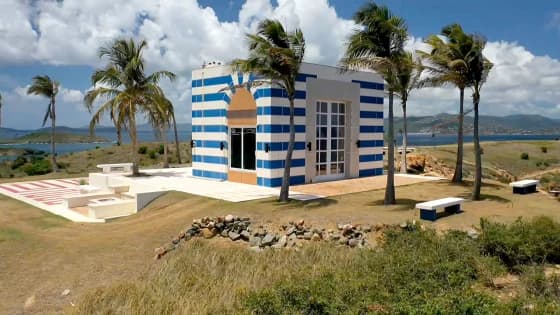
Drone photograph of the blue-and-white striped temple structure on Little St. James Island, Jeffrey Epstein's private island in the US Virgin Islands, surrounded by palm trees with the Caribbean Sea in the background
The blue-and-white striped temple structure on Little St. James Island, photographed by drone. The building, situated on the island's highest point, became one of the most recognizable symbols of the Epstein case.

Little St. James Island: Inside Jeffrey Epstein's Private Island, the Temple, and the $105 Million USVI Settlement

How a 70-acre Caribbean island became the most notorious private property in America — from its blue-and-white striped temple and compound of buildings visible in drone footage, to FBI surveillance, victim testimony about captivity on the island, and the historic $105 million settlement that the US Virgin Islands government extracted from Epstein's estate.

Sources: USVI AG Civil Complaint, FBI Investigation, Court Documents, Drone Imagery

The Island in the Caribbean

Little St. James is a 70-acre island in the United States Virgin Islands, located in the chain of small islands southeast of St. Thomas. Jeffrey Epstein purchased the island in 1998, transforming it from largely undeveloped land into a sprawling private compound over the following two decades. The island sits roughly a mile off the southeastern coast of St. Thomas, visible from passing boats and the adjacent island of Great St. James, which Epstein would later also purchase.

The island's development was extensive. Over twenty years, Epstein constructed a main residential compound, multiple guest houses, staff quarters, maintenance buildings, a commercial kitchen, a helipad, a private dock, an amphitheater-style terraced area, and significant landscaping including imported palm trees. The property also featured a private beach, a swimming pool, and paved roads connecting the various structures. The total investment in development was estimated in the tens of millions of dollars.

The Blue-and-White Striped Temple

The most visually distinctive and widely discussed structure on Little St. James was a rectangular building situated on the island's highest point. The structure featured bright blue-and-white horizontal stripes on its exterior walls and was topped with a gold-colored dome or cupola. The building's unusual appearance — described by media as resembling a temple — drew intense public curiosity and speculation, particularly after drone footage and satellite imagery of the island began circulating online.

The structure's front entrance featured large white double doors, and the building was surrounded by a paved terrace area with white benches. Red-and-white striped accents were visible on a staircase leading to the entrance. The building was flanked by tall palm trees and overlooked the Caribbean Sea, with views toward neighboring islands.

The purpose of the structure has been the subject of considerable debate. Some reports described it as a music room or practice space; others characterized it as a gym or recreation building. Former employees and visitors provided varying accounts. What is established from drone footage and satellite imagery is that the building underwent modifications over the years — the gold dome was removed at some point and the exterior appearance changed between different periods of aerial photography. The modifications suggested ongoing construction and renovation activity on the island.

Never-Before-Seen Images and Drone Surveillance

Public awareness of the island's layout and structures expanded dramatically through drone footage captured by journalists and private citizens. Beginning in 2019, high-resolution aerial images and video of the island were widely published, revealing details of the compound that had previously been visible only in low-resolution satellite imagery. These drone photographs showed the temple structure, the main house, guest buildings, the amphitheater area, and ongoing construction activity in unprecedented detail.

The FBI also conducted aerial surveillance of the island as part of its investigation. Federal agents executed search warrants on Little St. James in August 2019, following Epstein's arrest. The raid involved FBI agents arriving by boat, and photographs from the search showed agents processing evidence from multiple buildings on the compound. The scope of the island raid paralleled the earlier search of Epstein's Manhattan townhouse, with agents cataloguing materials throughout the property.

Steve Scully, a contractor who had worked on construction projects on the island, became a key source of evidence. Scully provided the FBI with security camera footage from Little St. James and testified about what he had observed during his time working on the property. His account included details about the movement of young women on and off the island, contributing to the body of evidence that prosecutors used to establish the trafficking operation.

Victim Testimony: Isolation and Control

Multiple victims described their experiences on Little St. James in court testimony and depositions. The accounts consistently emphasized the extreme isolation of the island setting and Epstein's use of that isolation as a mechanism of control. Survivors described being flown to St. Thomas — typically aboard Epstein's Boeing 727 or Gulfstream IV — and then transported to the private island by boat or helicopter.

Once on the island, victims reported that their freedom of movement was severely restricted. Some described having their passports confiscated upon arrival. Access to boats and communication equipment was controlled by Epstein and his staff. The nearest populated area — the southeastern coast of St. Thomas — was visible across the water but unreachable without a boat. This geographical isolation, combined with active surveillance and staff control, created conditions where victims felt unable to escape or seek help.

The island earned the grim colloquial nickname "Pedophile Island" among locals in the US Virgin Islands. Boat operators, taxi drivers, and residents of St. Thomas told investigators and journalists that a regular flow of young women traveling to the island was widely known in the local community. Some local workers were employed on the island for construction and maintenance, and their observations later contributed to the evidentiary record.

The USVI Government Lawsuit and $105 Million Settlement

In January 2020, the US Virgin Islands government, led by Attorney General Denise George, filed a civil lawsuit against Jeffrey Epstein's estate. The complaint alleged a decades-long pattern of sex trafficking and forced labor on Little St. James, with victims as young as 12. The suit detailed how Epstein used the island's isolation to control victims, confiscating passports and restricting access to boats and communications. The complaint also alleged that Epstein used a network of shell companies registered in the Virgin Islands to obscure his ownership and continue trafficking activities.

The lawsuit further alleged environmental violations connected to Epstein's development of both Little St. James and the adjacent Great St. James Island, which he purchased in 2016 for $18 million. Construction on Great St. James was conducted without proper permits, according to the complaint, causing damage to coral reefs, mangrove habitats, and other protected coastal ecosystems.

Attorney General George was controversially terminated from her position shortly after filing the lawsuit, a decision that drew widespread criticism and allegations of political interference. However, the case continued under her successors and ultimately resulted in a landmark settlement.

In November 2023, Epstein's estate reached a $105 million settlement with the USVI government — one of the largest settlements in the territory's history. The agreement included monetary compensation, the transfer of both Little St. James and Great St. James islands to the USVI government, and commitments regarding the future use of the properties. The settlement resolved the government's claims of trafficking, forced labor, conspiracy, and environmental damage.

The $105 million settlement amount encompassed cash payments from Epstein's estate as well as the value of the two islands and other assets. The USVI government committed to using a significant portion of the proceeds to fund programs for victims of sexual violence and human trafficking in the territory. The settlement also included provisions for ongoing monitoring and environmental remediation of the island properties.

Great St. James: The Second Island

Epstein's acquisition of Great St. James Island in 2016 for approximately $18 million expanded his Caribbean holdings to encompass both islands flanking the narrow channel southeast of St. Thomas. At 165 acres, Great St. James was more than twice the size of Little St. James. At the time of Epstein's arrest, the island was in the early stages of development, with heavy equipment, cleared land, and foundations visible in aerial photography.

Great St. James had historically been accessible to the public for day trips, beach visits, and hiking. Epstein's purchase and privatization of the island was met with frustration from USVI residents who lost access to areas they had used for generations. The environmental damage caused by unpermitted construction on Great St. James formed a significant component of the USVI government's lawsuit and was addressed in the settlement terms.

Flight Logs: The Island Connection

Flight logs from Epstein's aircraft documented hundreds of trips to and from the Cyril E. King Airport in St. Thomas, the nearest commercial airport to Little St. James. The Boeing 727 (N908JE) and Gulfstream IV (N120JE) regularly flew routes between Teterboro Airport in New Jersey, Palm Beach International Airport, and St. Thomas, creating a well-documented air bridge connecting Epstein's properties.

From St. Thomas, passengers were transported to Little St. James by boat or by Epstein's helicopter, which operated from the island's helipad. The combination of private aviation and private marine transport meant that visitors to the island could travel from mainland US locations to the private compound with minimal interaction with commercial infrastructure or public oversight — a logistical advantage that prosecutors argued was deliberately designed to facilitate trafficking.

The Islands After Epstein

Following the 2023 settlement, both Little St. James and Great St. James were transferred to the USVI government. The future of the islands remains a subject of public discussion in the Virgin Islands. Proposals have ranged from conservation use to memorial purposes. Environmental remediation of construction damage on both islands was included in the settlement terms, with particular attention to the coastal ecosystems on Great St. James.

The story of Little St. James Island encapsulates the geographic scope and deliberate infrastructure of Epstein's criminal operation. The island — with its isolation, its private dock and helipad, its surveillance systems, and its connection to Epstein's fleet of private aircraft — represented both a tool of the trafficking enterprise and a symbol of the impunity that characterized Epstein's decades of criminal activity before his 2019 arrest.

Timeline: Little St. James Island

1998

Jeffrey Epstein purchases Little St. James Island in the US Virgin Islands

1998-2018

Compound developed over 20 years: main house, guest houses, helipad, dock, temple structure, and extensive landscaping

2016

Epstein purchases adjacent Great St. James Island (~165 acres) for approximately $18 million

2019

Drone footage and aerial images of island compound circulate widely, revealing temple and buildings in detail

July 6, 2019

Epstein arrested at Teterboro Airport on federal sex trafficking charges

Aug 2019

FBI executes search warrant on Little St. James; agents process evidence from multiple buildings

Aug 10, 2019

Epstein found dead at Metropolitan Correctional Center

Jan 2020

USVI Attorney General Denise George files civil lawsuit against Epstein's estate alleging trafficking and environmental violations

Jan 2020

AG George terminated shortly after filing suit; case continues under successors

Nov 2023

Epstein estate reaches $105 million settlement with USVI government; both islands transferred to territory

2024+

Environmental remediation underway; future use of islands under USVI government deliberation

Related Evidence & Sections

All information sourced from USVI Attorney General civil complaint, FBI investigation records, court documents, publicly available drone imagery, and trial testimony. Property photographs are editorial images used under fair use for documentary and educational purposes.

Privacy|Terms