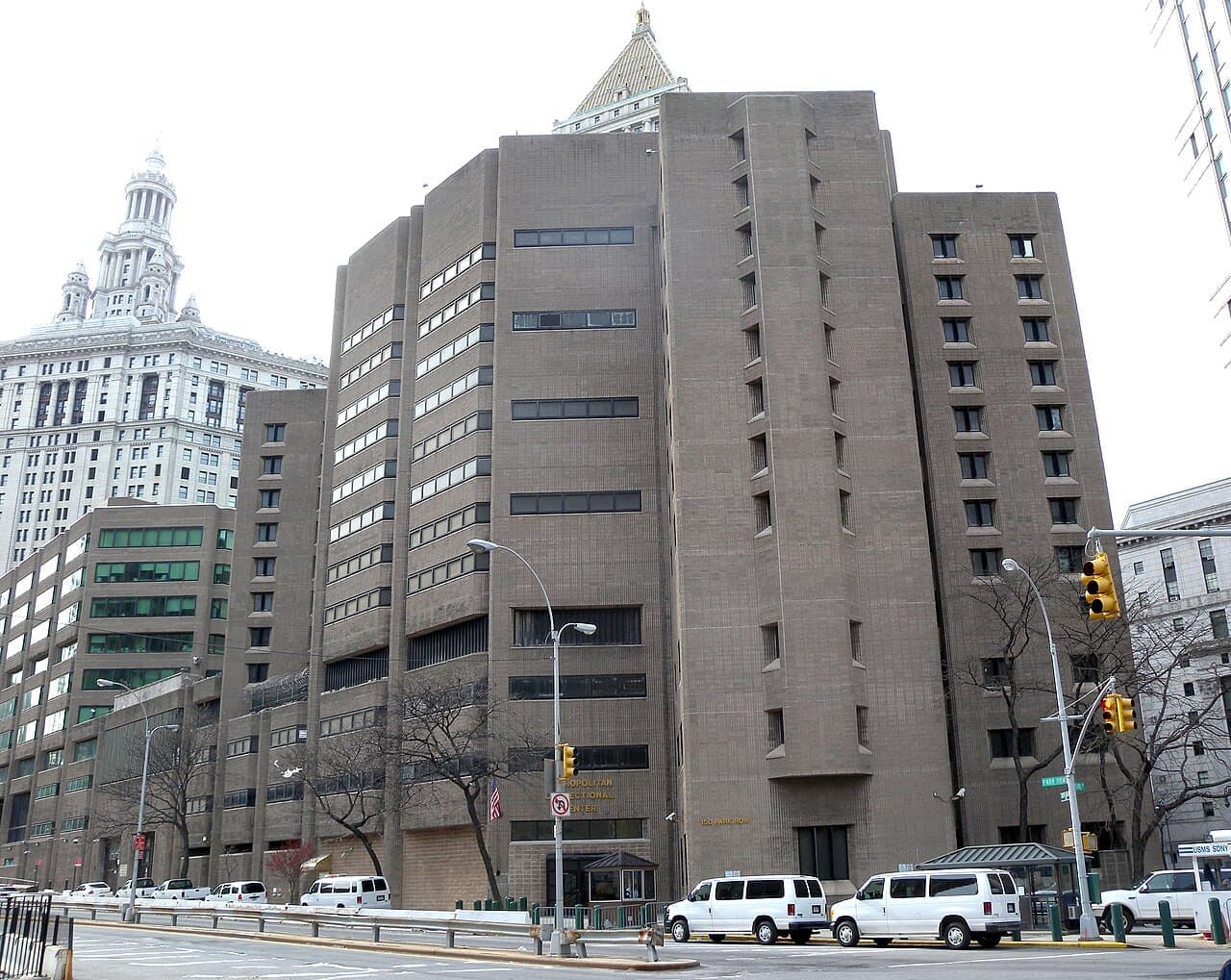
Metropolitan Correctional Center, New York
Epstein's Death at the Metropolitan Correctional Center: What Happened on August 10, 2019
How the most high-profile federal prisoner in America was found dead in his cell after a cascade of security failures — and why the official ruling of suicide has never silenced the questions.
The Metropolitan Correctional Center
The Metropolitan Correctional Center, commonly known as the MCC, was a federal detention facility located at 150 Park Row in Lower Manhattan, just blocks from City Hall and the Brooklyn Bridge. Opened in 1975, the 12-story brutalist concrete structure was operated by the Federal Bureau of Prisons and designed to hold approximately 449 inmates awaiting trial or sentencing in federal courts. The facility had long been plagued by chronic understaffing, deteriorating infrastructure, and administrative dysfunction. A 2019 Department of Justice Office of Inspector General report, completed before Epstein's death, documented severe staffing shortages that forced non-correctional employees to serve as guards — a practice known as "augmentation" — and identified systemic failures in maintaining basic safety protocols.
Despite its troubled reputation, the MCC housed some of the most prominent defendants in American legal history: Mafia boss John Gotti, Ponzi scheme architect Bernie Madoff, Mexican drug lord Joaquin "El Chapo" Guzman, and terrorist conspirator Omar Abdel-Rahman all passed through its cells. Jeffrey Epstein arrived at the MCC on July 6, 2019, following his arrest at Teterboro Airport and the denial of his $100 million bail package by Judge Richard Berman on July 18. He was assigned to the Special Housing Unit (SHU), a segregated wing for high-profile or at-risk inmates.
The First Incident: July 23, 2019
On July 23, 2019 — just five days after being denied bail — Epstein was found on the floor of his cell with marks on his neck. His cellmate at the time was Nicholas Tartaglione, a former police officer facing quadruple murder charges. The circumstances of this incident were never fully clarified. Epstein told investigators that Tartaglione had roughed him up; Tartaglione's attorney denied any involvement. Some reports suggested Epstein may have attempted to injure himself. Regardless of the cause, the incident triggered the facility's suicide prevention protocol: Epstein was placed on suicide watch, moved to a special observation cell, and monitored around the clock by a psychologist.
The suicide watch designation meant that Epstein was stripped of his clothing and given a paper-like "suicide smock," placed in a cell with no bedsheets or items that could be used for self-harm, and observed by a guard stationed directly outside his cell at all times. These conditions lasted approximately six days.
Removal from Suicide Watch: July 29, 2019
On July 29, Epstein was removed from suicide watch at the recommendation of the facility's psychologist. This decision would become one of the most scrutinized actions in the entire case. According to BOP protocols, removal from suicide watch required sign-off from qualified mental health staff who determined that the inmate no longer posed an imminent risk. Epstein was returned to a standard SHU cell, given regular clothing and bedding, and his monitoring was reduced to the unit's standard check schedule — guards were required to make rounds and visually confirm each inmate's status every 30 minutes.
The removal from suicide watch was made despite Epstein facing federal sex trafficking charges carrying up to 45 years in prison, having been denied bail, and having been involved in a neck injury incident less than a week earlier. Critics would later argue that under any reasonable assessment, Epstein should have remained under continuous observation for weeks if not months. The MCC psychologist who approved the removal was not disciplined.
The Night of August 9-10, 2019
The overnight shift on August 9-10 was assigned to two guards: Tova Noel, a correctional officer, and Michael Thomas, who was not a full-time correctional officer but had been "augmented" into the guard role due to chronic staffing shortages. Both had been working significant overtime. Thomas was on his fifth overtime shift in that week; Noel was also on overtime. Their assignment was to conduct rounds of the SHU every 30 minutes throughout the night.
According to the subsequent federal investigation, neither Noel nor Thomas made the required rounds for approximately eight hours — from roughly 10:30 PM on August 9 until approximately 6:30 AM on August 10. Federal prosecutors alleged that both guards fell asleep at their desk for extended periods and browsed the internet on their computers, with Noel searching for furniture sales and Thomas browsing motorcycle accessories and sports news. They then falsified the unit log, signing off on rounds that were never conducted.
At approximately 6:30 AM on August 10, 2019, when Noel and Thomas finally conducted a round, they found Jeffrey Epstein unresponsive in his cell. He had what appeared to be a bedsheet around his neck, attached to the upper bunk of the cell. Emergency medical services were called and attempted resuscitation, but Epstein was pronounced dead at New York-Presbyterian Lower Manhattan Hospital.
Security Camera Failures
In the days following Epstein's death, it emerged that at least two security cameras in the hallway outside his cell had malfunctioned during the critical overnight hours. The footage from these cameras was found to be unusable. Federal prosecutors initially stated that the footage had been lost; the MCC later located some additional footage from other cameras, but none captured the area directly in front of Epstein's cell during the gap in guard rounds. The camera failures added to the growing public skepticism about the official account and fueled conspiracy theories about whether Epstein's death was what it appeared to be.
The Autopsy Dispute: Sampson vs. Baden
On August 16, 2019, New York City Chief Medical Examiner Dr. Barbara Sampson ruled Epstein's death a suicide by hanging. The ruling was based on a full autopsy examination conducted by her office. However, the autopsy findings included a detail that would generate enormous controversy: Epstein had multiple fractures in his neck bones, including a fracture of the hyoid bone — a small, horseshoe-shaped bone in the throat.
Hyoid bone fractures can occur in both hanging and manual strangulation. Medical literature indicates that while hyoid fractures are found in a percentage of suicidal hangings — particularly in older individuals whose hyoid has calcified and become more brittle — they are significantly more common in cases of homicidal strangulation. Dr. Sampson maintained that the totality of the evidence, including the scene investigation and the pattern of injuries, was consistent with suicidal hanging.
Dr. Michael Baden, one of the most prominent forensic pathologists in the United States and a former New York City Chief Medical Examiner himself, was retained by Epstein's brother Mark to observe the autopsy. Baden publicly stated that the injuries he observed were more consistent with homicidal strangulation than with suicide by hanging. He pointed specifically to the number of fractures — three in total — and their bilateral pattern as unusual for a hanging. Baden also noted that the ligature furrow on Epstein's neck was not consistent with the bedsheet-and-bunk mechanism described in the official account. Dr. Sampson rejected Baden's conclusions, stating that she stood by her ruling.
AG William Barr and the Official Response
Attorney General William Barr initially expressed skepticism and anger at the circumstances of Epstein's death. On the day of Epstein's death, Barr issued a statement saying he was "appalled" and that the case "will continue on against anyone who was complicit with Epstein." He later ordered the Bureau of Prisons to temporarily reassign Warden Lamine N'Diaye and place the two guards on administrative leave. In subsequent public remarks, Barr described the sequence of events as a "perfect storm of screw-ups" but stated that his personal review of the evidence, including video footage and investigative findings, satisfied him that Epstein had died by suicide. Barr said he found "nothing to suggest" foul play.
The Guards' Legal Proceedings
In November 2019, Tova Noel and Michael Thomas were indicted on federal charges of conspiracy and filing false records related to their fabrication of the guard logs. They were not charged with any crime related to Epstein's death itself — only with the cover-up of their failure to conduct rounds. In May 2021, both guards entered into deferred prosecution agreements with federal prosecutors, avoiding prison time in exchange for completing community service hours and cooperating with ongoing investigations. The agreements required each to complete 100 hours of community service and submit to a six-month period of supervised release. The deals were criticized by victims' advocates who argued that the guards' negligence had directly enabled Epstein's death and denied survivors the chance to confront him at trial.
Victims Denied Their Day in Court
The most consequential impact of Epstein's death was its effect on the criminal case. Dozens of women who had been identified as victims in the federal indictment were preparing to testify against Epstein in what would have been one of the highest-profile sex trafficking trials in American history. Many had waited years — some more than a decade — for the opportunity to face their abuser in open court. Courtney Wild, Virginia Giuffre, and other named accusers had already provided depositions and were cooperating with the SDNY prosecution team.
Under federal law, a criminal case against a defendant ends upon the defendant's death. On August 29, 2019, Judge Berman formally dismissed the indictment against Epstein. While some of the evidence gathered for the Epstein case was later used in the prosecution of Ghislaine Maxwell, who was convicted in December 2021, the principal defendant would never stand trial. For many survivors, this represented a second failure of the justice system, following the controversial 2008 plea deal in Palm Beach that had allowed Epstein to plead guilty to state charges and avoid federal prosecution for more than a decade.
"Epstein Didn't Kill Himself": A Cultural Phenomenon
Within weeks of Epstein's death, the phrase "Epstein didn't kill himself" became one of the most widely circulated expressions in American popular culture. What began as speculation on social media platforms quickly crossed into the mainstream: the phrase appeared on bumper stickers, T-shirts, protest signs, and internet memes. A former Navy SEAL uttered the phrase on live television during a Fox News interview about an unrelated topic, generating millions of views. The meme format typically involved inserting the statement as a non sequitur at the end of an otherwise normal text or conversation.
The phenomenon reflected a broader crisis of institutional trust. A Rasmussen poll conducted in late 2019 found that only 29% of Americans believed Epstein had actually killed himself, while 42% believed he was murdered. The remaining respondents were undecided. This skepticism cut across political lines — both conservative and liberal commentators expressed disbelief at the official account, though they often differed on who they believed was responsible.
The Closure of the MCC
The Metropolitan Correctional Center was temporarily closed in 2021 amid ongoing concerns about conditions, safety, and infrastructure. The Justice Department announced plans to close the facility permanently, though its ultimate disposition remained in question. The building that had housed some of the most famous defendants in American legal history — and became internationally notorious as the site of Jeffrey Epstein's death — stood empty in Lower Manhattan, a physical monument to the systemic failures that defined its final years of operation.
Timeline: Epstein's Final Weeks
July 6, 2019
Epstein arrested at Teterboro Airport; booked into MCC same day
July 8, 2019
Federal indictment unsealed: two counts of sex trafficking and conspiracy
July 15, 2019
Bail hearing before Judge Richard Berman; prosecutors cite safe contents as flight risk
July 18, 2019
Judge Berman denies Epstein's $100 million bail package
July 23, 2019
Epstein found with marks on his neck in cell; placed on suicide watch
July 29, 2019
MCC psychologist removes Epstein from suicide watch after ~6 days
Aug 9, 2019 (evening)
Epstein's cellmate transferred; he is left alone in two-person SHU cell
Aug 9, 10:30 PM
Last confirmed guard check. Noel and Thomas cease rounds for ~8 hours
Aug 10, ~6:30 AM
Guards discover Epstein unresponsive in his cell with bedsheet ligature
Aug 10, 7:30 AM
Epstein pronounced dead at New York-Presbyterian Lower Manhattan Hospital
Aug 16, 2019
NYC Chief Medical Examiner Dr. Barbara Sampson rules death a suicide by hanging
Aug 29, 2019
Judge Berman formally dismisses the federal indictment
Oct 2019
Dr. Michael Baden publicly disputes the autopsy ruling, citing evidence consistent with strangulation
Nov 2019
Guards Noel and Thomas indicted on federal charges of conspiracy and falsifying records
May 2021
Both guards enter deferred prosecution agreements; no prison time